 First-Annual State of HR Identity Fraud Detection |
 Mercedes Anders, Director of Product Management, HYPR
 5 Min. Read | July 23, 2026
Our recent two-part deepfake series explored both sides of the AI identity challenge: first, how surprisingly easy it has become to create a convincing deepfake identity, and then how layered identity verification can defend against it. If you missed them, you can watch Part 1: How to Set Up a Deepfake and Part 2: How to Defend Against a Deepfake.
The barrier to creating convincing synthetic identities has fallen dramatically. The challenge for defenders is no longer simply recognizing that deepfakes exist, it’s building identity systems that know how to respond when they do.
Detecting the Deepfake Is Only the Beginning
When organizations evaluate identity verification platforms, one question almost always comes first:
“Can you detect deepfakes?”
It’s an important question. As generative AI becomes more accessible, organizations need confidence that AI-generated faces, voices, and videos won’t undermine their verification processes.
In our first livestream, we intentionally built a convincing synthetic identity using publicly available tools to demonstrate how accessible these attacks have become. In the second, we showed how layered identity verification—including document verification, biometric matching, liveness detection, and embedded deepfake detection—can expose those attacks before trust is established.
Detecting a deepfake is an essential capability, but it isn’t the final outcome of identity verification. It’s one piece of information that helps determine what should happen next.
That shift is reflected in emerging industry guidance as well. In its recent guidance on face morph detection (NIST IR 8584), NIST notes that organizations should think beyond deploying detection technology alone and consider how suspicious results are investigated and incorporated into operational identity workflows. The objective is greater than simply identifying manipulated media, but ensuring those signals inform appropriate identity decisions.
How Easy Has It Become to Create a Deepfake?
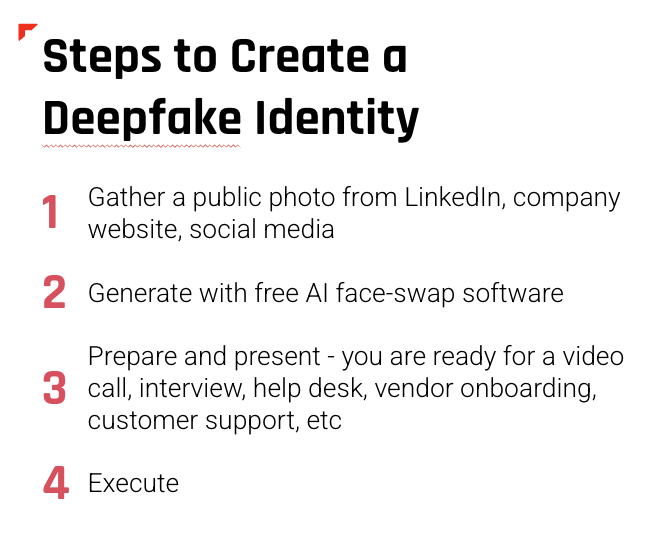
The attack path itself is remarkably straightforward. Public photos from LinkedIn or company websites can be combined with freely available face-swapping or voice-cloning software to create a convincing synthetic identity in minutes. That identity can then be presented during a virtual interview, help desk interaction, vendor onboarding, or customer verification process.
This is precisely why organizations can no longer rely on visual inspection or “spot the deepfake” training alone. The attacks have become easier to execute, while human judgment has become less reliable.
Identity Verification Cannot Be a Single Check
Deepfakes rarely exist in isolation.
A manipulated biometric may appear alongside an unfamiliar device, an unexpected location, repeated verification attempts, document anomalies, or inconsistencies in identity data. Viewed independently, each signal provides only a partial picture. Evaluated together, they offer a much stronger indication of whether an identity can be trusted.
That shift is changing how organizations approach identity verification. Rather than depending on a single technology or detection model, modern identity assurance increasingly relies on multiple layers of evidence to establish confidence in an identity—an approach that closely aligns with the risk-based identity proofing principles outlined throughout NIST’s Digital Identity Guidelines.
HYPR Affirm evaluates approximately 55 risk signals across biometric analysis, document intelligence, location intelligence, identity intelligence, and OTP verification to build a more complete picture of identity risk throughout the verification process.
Every stage contributes additional evidence. Deepfake detection becomes one signal among many, helping inform the overall confidence in a user’s identity.
Turning Risk Intelligence into Action
Collecting more signals alone does not automatically improve security. Organizations also need a consistent way to decide how those signals should influence the verification workflow. That operational perspective is increasingly shaping modern identity assurance platforms. Rather than treating detection as a standalone event, organizations are looking for ways to consistently evaluate risk, apply policies, and document the resulting decisions.
That philosophy shaped one of the newest capabilities in HYPR Affirm: Risk Policy Builder.
Rather than treating every verification as a static pass/fail event, organizations can define how combinations of risk signals should influence each protected action within a workflow. Policies can determine whether a verification proceeds, requires additional verification, is escalated for review, redirected, or denied, while configurable retry budgets and detailed audit logging help security teams adapt as attack techniques evolve.
Now, every verification reaches an outcome that’s appropriate for the context in which it occurs.
Deepfake Defense Is an Operational Challenge
Our deepfake demonstrations were never just about showing how quickly AI-generated identities can be created—or even how they can be detected. They were about illustrating how identity assurance is evolving.
As synthetic media becomes easier to produce, organizations will need more than accurate detection models. They’ll need verification systems that evaluate identity holistically, adapt to changing threats, and consistently translate risk into action.
That’s where the industry is heading: away from isolated verification checks and toward identity systems that make smarter, more contextual decisions.

Frequently Asked Questions
Is deepfake detection enough to prevent identity fraud?
Deepfake detection is an important layer of identity verification, but it should be considered alongside other signals such as document authenticity, biometric matching, liveness detection, device ownership, location intelligence, and identity consistency. Evaluating those signals together provides a more complete assessment of identity risk.
What are identity risk signals?
Identity risk signals are indicators collected throughout the verification process that help establish confidence in a user’s identity. These can include biometric analysis, document validation, location intelligence, OTP verification, device ownership, and identity consistency checks. HYPR Affirm evaluates approximately 55 risk signals across these verification stages.
Why are configurable risk policies important?
Organizations have different risk tolerances and regulatory requirements. Configurable policies allow security teams to define how combinations of risk signals should influence verification outcomes, ensuring that responses are appropriate for the context rather than relying on a single pass/fail threshold.
How do retry policies strengthen deepfake defenses?
Attackers rarely stop after a single failed attempt. Retry policies allow organizations to limit repeated verification attempts within a defined time window, helping prevent attackers from continuously testing different techniques until one succeeds while providing additional behavioral context during the verification process.
